
In short
- One task per session, small enough to make progress on in 25 minutes.
- Set up before you start: what you need open, what you need closed.
- Write distractions down instead of acting on them.
- Take a real break away from the screen, then go again.
A timed session works because it makes the task smaller. You aren’t writing an essay; you’re working on one section for 25 minutes. When the timer ends, you’ve done something, and stopping is part of the plan.
Run a session in five steps
Pick one task
Not “work on the essay” but “write the paragraph on the second study” or “read pages 10 to 20 and note three points”. If the task is too big for a session, break it down first.
Set up
Open only what the task needs: the document, the notes, the source. Close the rest. Put your phone in another room, or at least face down and silent.
Start the timer and start the task
Begin with the easiest part of it, to get moving. The first few minutes are the hardest; they pass.
Park distractions
A thought, a worry, a thing to look up: write it on a note and carry on. You can deal with it in the break.
Take a real break
Five minutes away from the screen. After three or four sessions, take a longer break of 15 to 30 minutes.
Why short sessions help
Starting is the hardest part of most work, and a big task is hard to start. A timer shrinks the task to something you can face: not the whole report, just the next 25 minutes of it. Knowing a break is coming makes it easier to stay with something dull, and stopping on time means you come back to it fresher.
It also shows you where the time goes. After a week of sessions, you’ll know how long a section really takes you, which makes the next plan more honest.
What a good day can look like
| Session | Task |
|---|---|
| 1 | Re-read yesterday’s paragraph and write the next one |
| 2 | Find the page number for two quotes and add the citations |
| Long break | Lunch, away from the desk |
| 3 | Write the paragraph on the counter-argument |
Three sessions is about an hour and a quarter of real work. Most days, that’s plenty. Two or three focused sessions a day will get a 2,000-word essay done in two weeks without an all-nighter.
When sessions don’t stick
- You never start. Make the first task smaller, and the session shorter. Ten minutes counts.
- You stop halfway every time. The task is probably vague. Write down exactly what “done” looks like before you start.
- The breaks turn into an hour. Set a timer for the break too, and decide the next task before you stand up.
 Focus in KanBananza
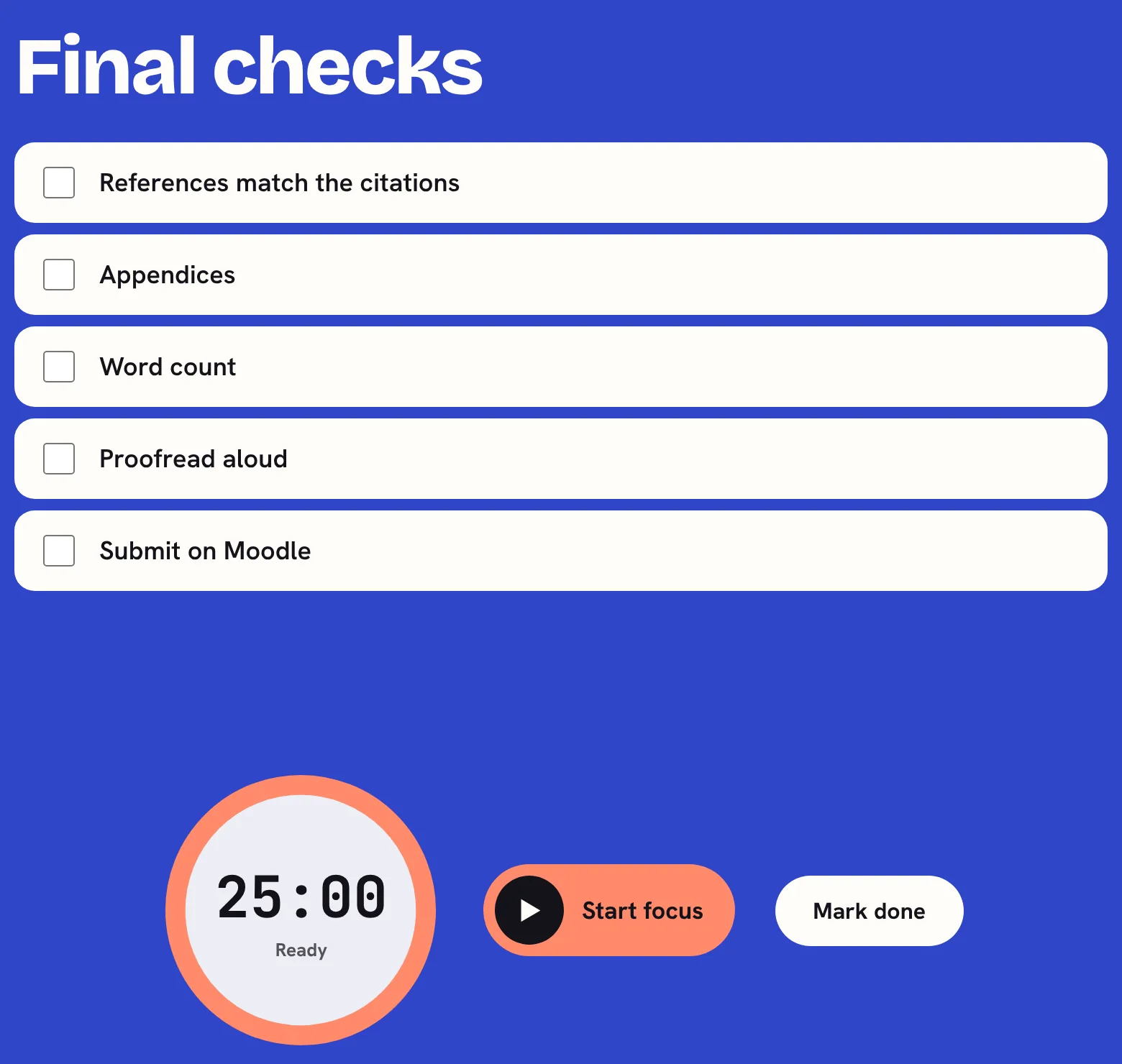
- Twenty-five minutes is hard to protect. A focus timer on every card (Focus on this card), with short and long breaks; it can show as a shrinking disc instead of numbers (Settings → Reading and access). Free Just this card fills the screen with one card, its steps and the timer, and nothing else. Full Bananza
- You can’t decide what to do first. Pick one for me suggests a single card to do next, and says why. Free
- Someone can see your screen. Press B to blur everything, and again to bring it back. Free
For you
Revision
One topic per session, and end each one by writing three things you remember without looking.
Essays and reports
One section or paragraph per session. Leave the last sentence half-finished, so the next session is easy to start.
Work and home
Batch small jobs into one session: five emails, three phone calls, one form.
Questions
How long should a focus session be?
Twenty-five minutes, then a five-minute break, is a good place to start. If that’s too long to stay on one thing, try fifteen. If you keep wanting to carry on, try forty-five. The length matters less than doing several, most days.
What should I do in a break?
Something away from the screen: stand up, get a drink, look out of the window. Scrolling on your phone isn’t a break for your attention, and it makes the next session harder to start.
What if I get distracted halfway through?
Write the distraction down and go back to the task. If it really can’t wait, stop the timer, deal with it, and start a fresh session afterwards. One interrupted session isn’t a failed day.
Do focus timers help with ADHD?
Many people with ADHD find that a visible timer makes time easier to feel, and a short session easier to start. Everyone’s different: try different lengths and see what works for you.
KanBananza is free in your browser, nothing to install. No account, no tracking, and every accessibility option included.
Also as an app for Mac and Windows. Full Bananza from £9 a year, or try it free for 7 days.