
In short
- Pick a structure that fits the task: essay, report or dissertation.
- Give each part a share of the word count.
- Make one card per section or chapter, with its main point, steps and a due date.
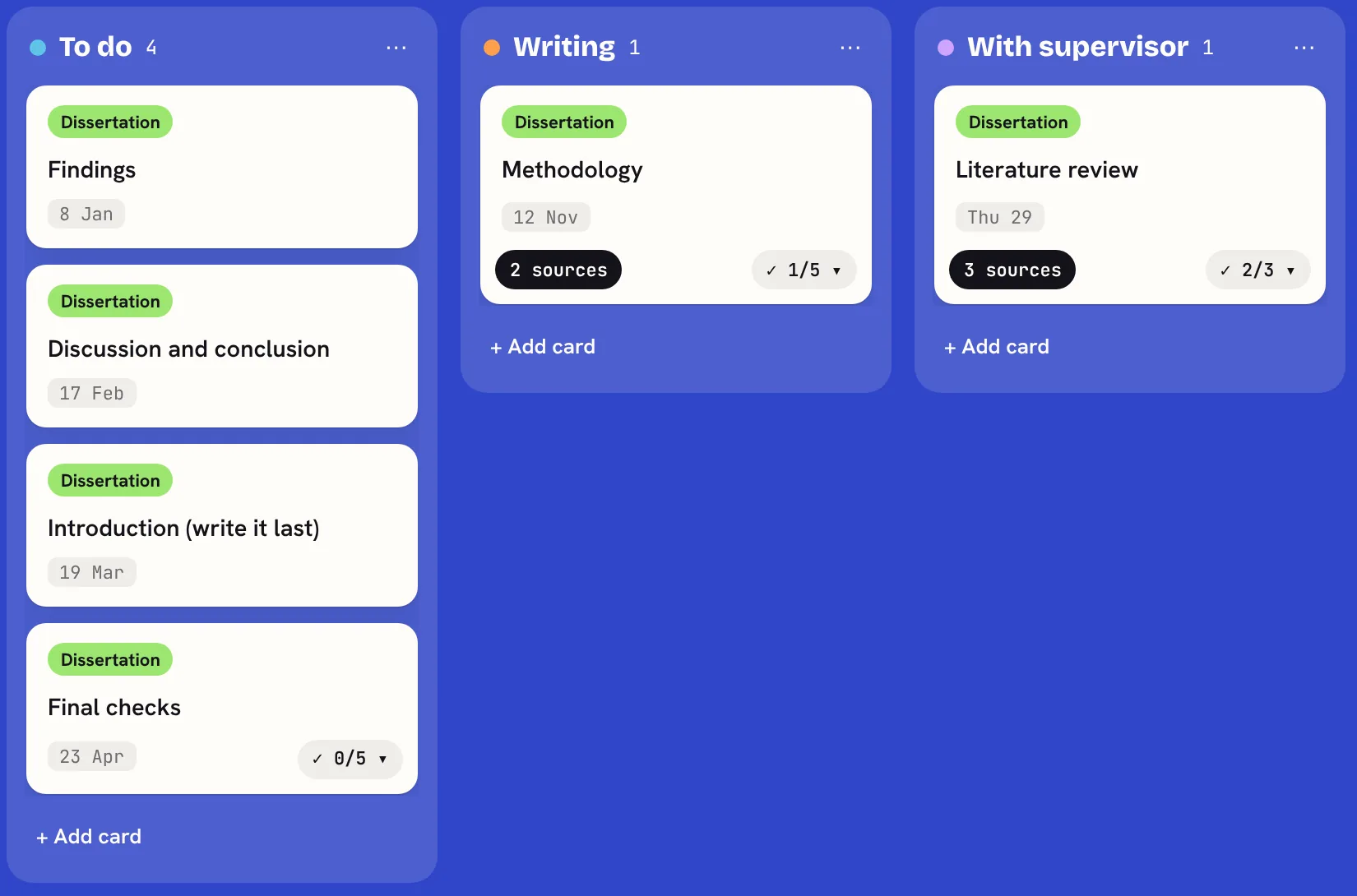
- Use columns for how far each has got: to do, writing, with supervisor, redrafting, done.
- Write in the order that’s easiest, not the order it’s read in.
Ten thousand words is frightening. A 1,500-word methodology due on the 12th is just a task. Breaking a long piece into sections, each on its own card, turns one impossible job into a few possible ones, and the board shows you progress you can actually see.
This is step 5 of planning an assignment from start to finish.
Pick a structure
| Kind | Usual sections |
|---|---|
| Essay | Introduction, three to five main sections that each make one point, conclusion |
| Report | Summary, introduction, method, findings, discussion, conclusion or recommendations, references, appendices |
| Lab report | Abstract, introduction, method, results, discussion, references |
| Reflective writing | Often a model, like Gibbs’ reflective cycle: description, feelings, evaluation, analysis, conclusion, action plan |
| Dissertation | Abstract, introduction, literature review, methodology, findings, discussion, conclusion, references, appendices |
Your handbook may set the sections, so check it first.
Give each part a word count
A word count for each section stops one part swallowing the rest. These shares are a common starting point for a 10,000-word dissertation; adjust them to your subject and your handbook.
| Chapter | Share | Words |
|---|---|---|
| Introduction | 10% | 1,000 |
| Literature review | 25 to 30% | 2,500 to 3,000 |
| Methodology | 15% | 1,500 |
| Findings | 20% | 2,000 |
| Discussion | 20% | 2,000 |
| Conclusion | 5 to 10% | 500 to 1,000 |
For a 2,000-word essay: about 200 words of introduction, 1,600 for the main sections (around 400 each for four points), and 200 for the conclusion.
Make it a board
One card per section or chapter
Put the word count in the title, like “Literature review (3,000 words)”, or in the card’s notes with the section’s main point in one sentence.
Columns for how far each has got
To do, Writing, With supervisor, Redrafting, Done. Moving a card is a small win you can see.
Steps inside each card
The sub-sections or jobs within a chapter, as a checklist: “Search terms”, “Key sources”, “Themes and gaps”.
A due date on each
From your plan in step 2. Supervisor meetings get cards and dates too.
Notes for feedback
Paste your supervisor’s or teacher’s comments into the chapter’s notes, so they’re there when you redraft.
Limit what’s in progress
Writing three chapters at once means finishing none. Keep one or two cards in Writing at a time.
Write in the easiest order
- Start with what you know best. For a dissertation that’s often the methodology: you know what you did.
- Write the introduction last. It’s much easier to introduce something that exists.
- One section at a time. Finish a rough draft of a section before starting the next.
- Don’t polish too early. A complete rough draft is worth more than one perfect chapter.
 Plan chapters in KanBananza
- The ready-made Dissertation, chapter by chapter board has the columns above and a card for each chapter, from the proposal to the final checks. Essay or dissertation and Thesis or research project are there too. Free
- Checklists with + Add item. On the board, a card shows ✓ 2/3 ▾; press it to tick steps off without opening the card. Free
- Labels for chapters, themes or modules, and due dates on every card. Free
- Break it down with Pip suggests three to six small steps for a chapter; tick the ones you want. Pip
- Set a card limit on the Writing column, so you can’t start too many chapters at once. Full Bananza
For your level
School and college
Plan each paragraph of an essay as a step, using PEEL: point, evidence, explain, link. For the EPQ, your centre’s guidance gives the sections of the report; make each one a card.
University essays and reports
One card per main section, each with its point in one sentence. If you can’t write the sentence, the section isn’t ready to write.
Dissertations
One card per chapter, plus cards for the proposal, ethics, supervisor meetings and final checks. Put the word count in each title.
Master’s and PhD
Use one board for the whole thesis, and a separate board for a chapter that’s big enough to need its own sections and deadlines.
Questions
How many chapters should a dissertation have?
Most have five to seven: introduction, literature review, methodology, findings (or results), discussion, and conclusion, sometimes with findings and discussion together. Your handbook may set the structure, especially in sciences.
What order should I write the chapters in?
Rarely the order they’re read in. Many people write the methodology first (it’s the most concrete), then the literature review, findings and discussion, and the introduction, conclusion and abstract last, once they know what they’re introducing.
How long should a literature review be?
Often about a quarter to a third of a dissertation: 2,500 to 3,000 words in a 10,000-word dissertation. Check your handbook, as some subjects expect more or less.
How do I plan an essay structure?
An introduction that answers the question in brief, three to five main sections that each make one point with evidence, and a conclusion that pulls them together. Plan each main section as a card with its point and its sources.
What is PEEL?
A way to build a paragraph, taught in many UK schools: Point (what you’re arguing), Evidence (a source or example), Explain (how the evidence supports the point) and Link (back to the question or on to the next point).
All 7 steps
- Break down the brief
- Plan back from the deadline
- Find and save sources
- Reference as you go
- Plan the chapters
- Sources for each chapter
- Write, check and hand in
KanBananza is free for Chrome, Edge and Firefox. No account, no tracking, and every accessibility option included.
Add to Chrome, it's freeAlso for Edge and Firefox. Full Bananza from £5 a year, or try it free for 7 days.