
In short
- Find out your referencing style before you save your first source.
- Save the details each kind of source needs: the table below lists them.
- Cite as you write: an in-text citation goes in the moment you use an idea.
- Every citation needs a reference, and every reference needs a citation.
- Copy the finished reference list at the end, and check it once.
Referencing has two halves. In your writing, a short citation says where an idea came from, like (Walker, 2017, p. 81) or a footnote. At the end, the reference list gives the full details so a reader can find each source. Doing both as you go is faster, and it’s how you avoid plagiarism by accident.
This is step 4 of planning an assignment from start to finish.
Find out which style you need
Your course handbook or brief names the style. If it doesn’t, ask. These are the usual ones by subject, but universities and departments vary.
| Style | Usually used in | Citations look like |
|---|---|---|
| Harvard | Most UK universities, many subjects | (Walker, 2017, p. 81) |
| APA 7 | Psychology, education, nursing, social sciences | (Walker, 2017, p. 81) |
| MLA 9 | English, languages, humanities | (Walker 81) |
| Chicago | History and humanities (footnotes), some social sciences (author-date) | A footnote, or (Walker 2017, 81) |
| MHRA 4 | UK humanities | A footnote |
| OSCOLA 4 | Law | A footnote |
| Vancouver | Medicine, health, biomedical science | (1) or a raised number |
| IEEE | Engineering, computing, electronics | [1] |
| AMA | Medicine, especially US journals | A raised number |
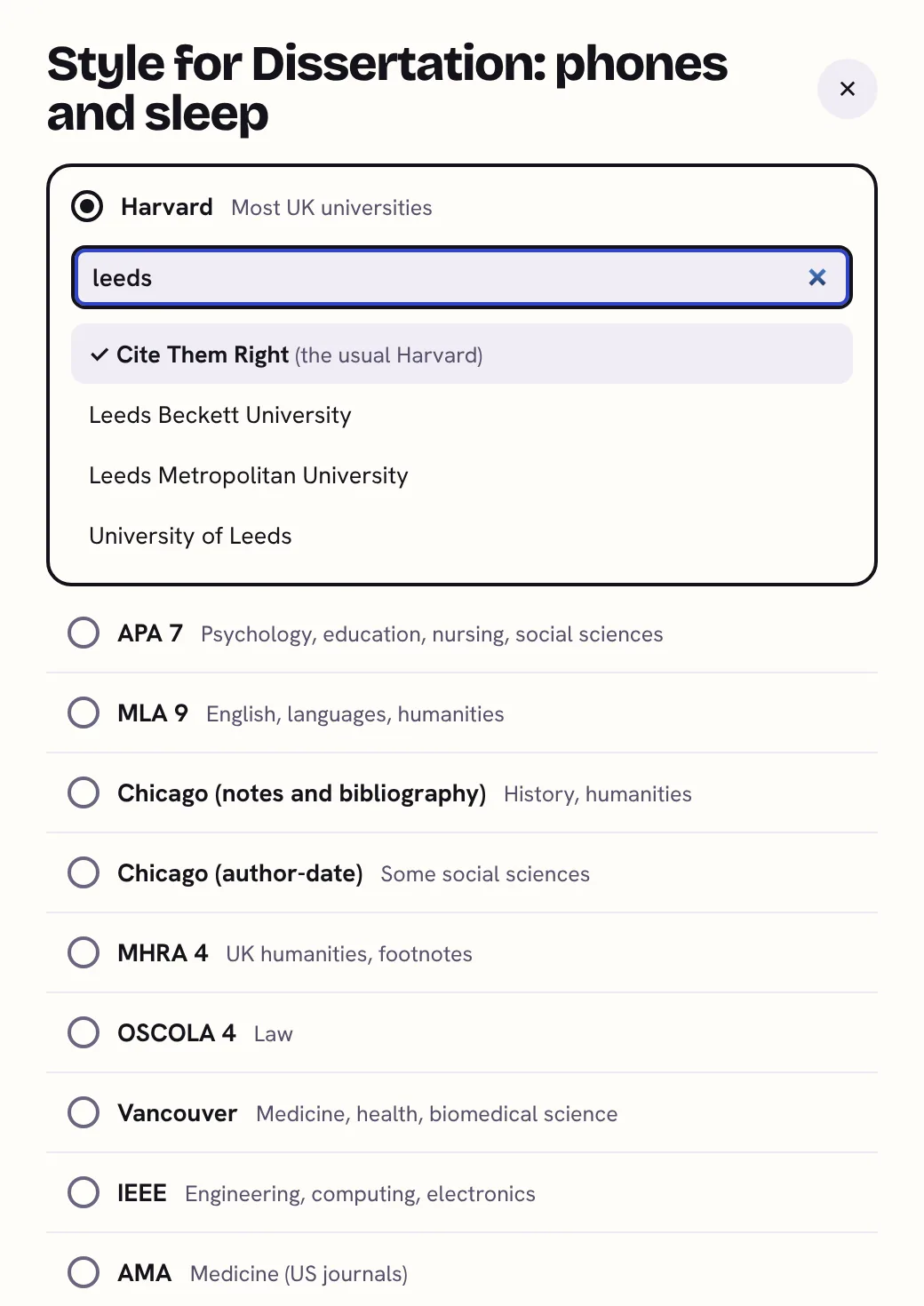
Harvard isn’t one single style: many universities publish their own version. See Harvard for your university.
What to save for each kind of source
Different sources need different details. Save these as you go and you’ll never have to find a book again just for its publisher.
| Source | Details to save |
|---|---|
| Book | Authors or editors, year, title, edition (if not the first), place of publication, publisher |
| Chapter in an edited book | The chapter’s authors and title, the book’s editors and title, year, publisher, page range |
| Journal article | Authors, year, article title, journal, volume, issue, page range, DOI |
| Web page | Author or organisation, date (or none), title, website name, web address, the date you looked at it |
| Report or guideline | Organisation or authors, year, title, report number, publisher, web address |
| News article | Author, date, title, newspaper or site, page or web address |
| Video or podcast | Creator or channel, date, title, where it’s published, web address |
| UK Act | Its short title with its year, and its chapter number (like c. 15) |
| UK case | Case name, its neutral citation or law report, and the court |
For anything you quote, save the page number too. Most styles need it in the citation for a quote, and some for any specific point.
Habits that save hours
- Cite while you write. Never leave “ref later” in a draft. Later is when it gets lost.
- Quotes in quotation marks, with the page. Your own notes kept apart from copied words.
- Paraphrase properly. Put the idea in your own words and still cite it: ideas need citations, not only quotes.
- Don’t trust copied references blindly. “Cite” buttons on websites are a start, but they often get capitals, editions or authors wrong.
- Check both ways at the end. Every citation is in the list, and everything in the list is cited.
 Referencing in KanBananza
- The style belongs to the board. The first Sources stack on a board asks what the board is for and suggests a style; change it any time with the style chip on the stack, like Harvard ▾. Every reference updates. Free
- Harvard (Cite Them Right) is free, with Copy references for the whole stack. Free
- Every other style (APA 7, MLA 9, Chicago, MHRA 4, OSCOLA 4, Vancouver, IEEE, AMA) and 110 university versions of Harvard. Full Bananza
- Each source shows Will paste as and its in-text citation, with anything missing highlighted. Free
- Copying gives rich text, so italics and hanging indents survive pasting into Word or Google Docs. If something’s missing, it tells you first.
- Export to Zotero, Mendeley, EndNote or Overleaf as RIS, BibTeX or CSL JSON from the Research library, and import from them too. Full Bananza
- Tidy with Pip fixes capital letters and the order of names in a source’s details. You see every change first, and it never adds new details. Pip
Referencing guides with examples
Each guide shows citations and references for books, articles, websites and more, made with KanBananza’s own formatter.
- HarvardMost UK universities
- Harvard for your university110 university versions
- APA 7Psychology, education, nursing
- MLA 9English, languages, humanities
- ChicagoFootnotes, or author-date
- MHRA 4UK humanities, footnotes
- OSCOLA 4Law, footnotes
- VancouverMedicine and health
- IEEEEngineering and computing
- AMAMedicine, US journals
For your level
School and college
Your school may use a simple form of Harvard. Coursework, NEA and the EPQ still need a reference list, and markers check it. Start one from the first source.
University essays and reports
Referencing is often marked directly, as part of “presentation” or “use of sources”. Accurate references are some of the easiest marks to get.
Dissertations
With 40 to 100 sources, saving as you go is the only sane way. Check your department’s version of the style, as small details differ.
Master’s and PhD
Hundreds of sources over years: keep one library, export it to a reference manager when you need one, and back it up.
Questions
What’s the difference between a reference list and a bibliography?
A reference list has only the sources you cited in your text. A bibliography can also include things you read but didn’t cite. Footnote styles like Chicago, MHRA and OSCOLA use a bibliography; Harvard and APA use a reference list. Your handbook says which you need.
Do I need to reference lecture slides?
If you use an idea or a fact from them, yes, unless your course says to cite only the original sources. Many tutors prefer you to find and cite the source the lecture used.
How do I reference something with no author?
Look for an organisation as the author first, like the NHS or a government department. If there really is none, most styles move the title into the author’s place. Each style guide below shows how.
What is secondary referencing?
Citing a source you read about in another source, without reading the original. Most styles allow it with “cited in” or “as cited in”, and you list only the source you actually read. Use it sparingly; finding the original is better.
Can I change my referencing style later?
In KanBananza, yes: the style belongs to the board, so change it and every reference on that board is formatted the new way. Other styles than Harvard are part of Full Bananza.
All 7 steps
- Break down the brief
- Plan back from the deadline
- Find and save sources
- Reference as you go
- Plan the chapters
- Sources for each chapter
- Write, check and hand in
KanBananza is free for Chrome, Edge and Firefox. No account, no tracking, and every accessibility option included.
Add to Chrome, it's freeAlso for Edge and Firefox. Full Bananza from £5 a year, or try it free for 7 days.