
In short
- Put your department’s dates on first: the proposal, ethics, any draft deadlines and hand-in.
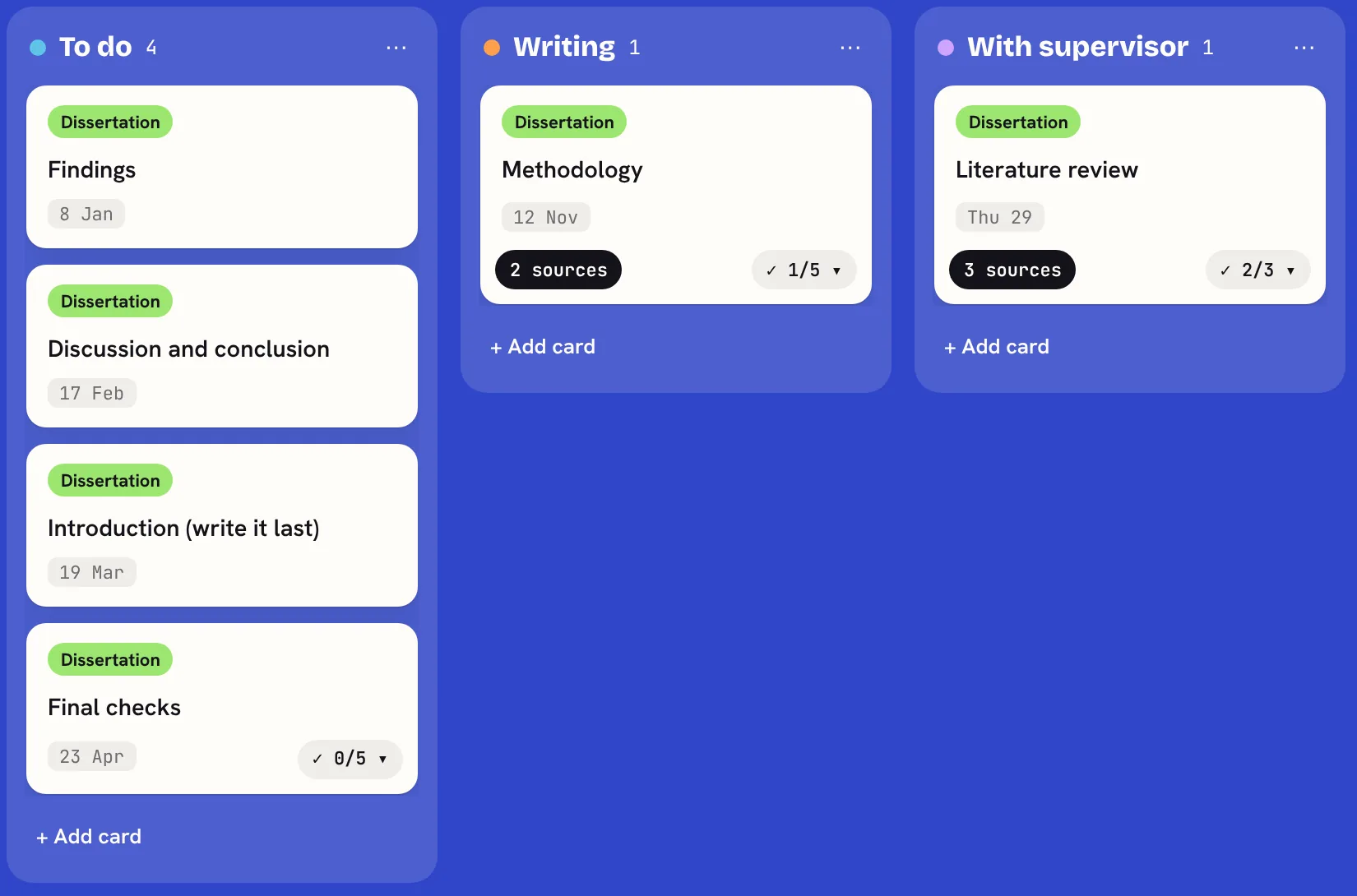
- Make a card for each chapter, and date them back from the hand-in.
- Book supervisor meetings as dated cards, each with something to bring.
- Keep the last week free, and plan one month at a time, one week at a time.
A dissertation is the longest piece of work most students write, and the only one where nobody tells you what to do each week. The deadline is months away, so nothing feels urgent until everything is. A plan turns it into a few close dates you can feel.
The chapters lesson explains what goes in each chapter. This guide is about when.
Plan it in five steps
Collect the fixed dates
Your department sets some dates for you: the proposal, the ethics application, any draft or progress deadlines, and the hand-in itself. Put these on first. They are your real deadlines, and everything else fits around them.
Make a card for each chapter
Introduction, literature review, methodology, findings, discussion, conclusion, plus the abstract and final checks. Your course may use different names or combine some; follow its handbook.
Date them back from the end
Keep the last week free. Then work back: final checks, the introduction (written last), the discussion and conclusion, the findings, data collection, the methodology, the literature review. The deadline guide shows how.
Book your supervisor meetings
Each meeting is a card with a date and one thing to bring: a plan, a draft, or two specific questions. A meeting with a draft to discuss is worth far more than one without.
Plan the month you’re in, by the week
The board shows the whole year. Each week, pick the chapter you’re working on and break this week’s part of it into small steps.
An example timeline
For a dissertation due at the end of April, started in October:
| When | What | Bring to your supervisor |
|---|---|---|
| October | Research question, proposal and ethics application | The proposal draft |
| November and December | Reading and the literature review | A plan of the review’s themes |
| January | Methodology, and collecting your data | The methodology draft |
| February | Analysis and the findings | Your first results |
| March | Discussion and conclusion, then the introduction | A full draft, if your department allows it |
| April | Final checks, the abstract, formatting, and a spare week before hand-in | Any last questions |
A taught Master’s dissertation often runs over a summer instead, so the same stages fit into three or four months. Scale the table, not the stages.
Common mistakes
- Reading forever. The literature review has an end date like everything else. When it arrives, start writing; you can add sources later.
- Writing the introduction first. You don’t know what the dissertation argues until it’s written. Draft it last.
- Leaving data collection late. Ethics approval, participants and equipment all take time you can’t control. Start these early.
- No spare time. Something will go wrong. A free week before hand-in absorbs it.
 Plan your dissertation in KanBananza
- Ten thousand words and one blank page. The ready-made Dissertation, chapter by chapter board has a card for each chapter, from the proposal to the final checks. Thesis or research project is there too, for Master’s and PhD. Free
- Feedback scattered across emails. Paste your supervisor’s comments into the chapter card’s notes, so they’re there when you redraft. Free
- Three chapters open, none finished. Set a card limit on the Writing column, so you can’t start too many at once. Full Bananza
For your level
EPQ
The same plan works at a smaller scale. Your production log is your supervisor meeting record: date each entry and bring something to each meeting.
Undergraduate
Your department’s handbook sets the chapter names and word limits. Read it before you make the cards.
Master’s and PhD
Long projects drift. Set a milestone every four to six weeks that someone else will see, like a chapter draft for your supervisor.
Questions
When should I start planning my dissertation?
As soon as you know your topic, and before your department’s proposal deadline. Most undergraduate dissertations run over five to seven months, and the reading and data collection take longer than students expect.
How long should each dissertation chapter take?
Roughly: a month for the literature review, a few weeks each for the methodology and findings, a few weeks for the discussion and conclusion, and the last month for the introduction, the abstract and final checks, with a spare week before hand-in. Your department’s draft dates come first.
How often should I meet my supervisor?
As often as your department allows, and always with something to discuss: a draft, a plan or a specific question. A meeting with a chapter draft is worth far more than a catch-up.
What if my dissertation plan slips?
Move the dates, not the deadline. Use the spare week first, shrink the stages that are left a little, and tell your supervisor early. Don’t cut the final checks.
KanBananza is free in your browser, nothing to install. No account, no tracking, and every accessibility option included.
Also as an app for Mac and Windows. Full Bananza from £9 a year, or try it free for 7 days.