
In short
- Write down the real deadline, with its time, and anything else taking your time.
- Keep the last 10% of the time free, and at least two days.
- Split the work into stages and give each one a date, working back from the end.
- Turn each stage into a card with a due date and a few small steps.
- Put the first step on today’s plan, and check the dates once a week.
“I’ve got three weeks” feels like plenty, which is exactly why it goes wrong. “The draft has to be done by the 10th” is a deadline you can feel today. Planning backwards turns one far-off date into five close ones.
This is step 2 of planning an assignment from start to finish. You’ll need the deadline and the details from step 1.
How to plan backwards
Write down the real deadline
The date and the time, and where it’s handed in. Then note what else is happening: other deadlines, shifts, exams, trips and birthdays.
Keep spare days at the end
Take about 10% of the time off the end, and at least two days, for things going wrong: a printer, an illness, a portal that’s down. Treat the day before the spare days as your deadline.
Split the work into stages
Use the steps from this guide: understand the brief, find sources, plan the structure, write, check. Big pieces split further, like a dissertation’s chapters.
Date each stage, from the end backwards
Checking first (the last few days before your spare days), then writing, then planning, then reading. Give the reading and writing the biggest share of the time.
Make each stage a card
A card per stage, with its due date and two to five small steps. Small steps are easier to start than “write essay”.
Start today
Pick the first small step and do it today, even for 20 minutes. Starting is the hardest part, and it gets easier once something is done.
Check the plan every week
Once a week, look at the dates. Ahead? Good. Behind? Move the dates and use some of the spare days, before it becomes a crisis.
A worked example
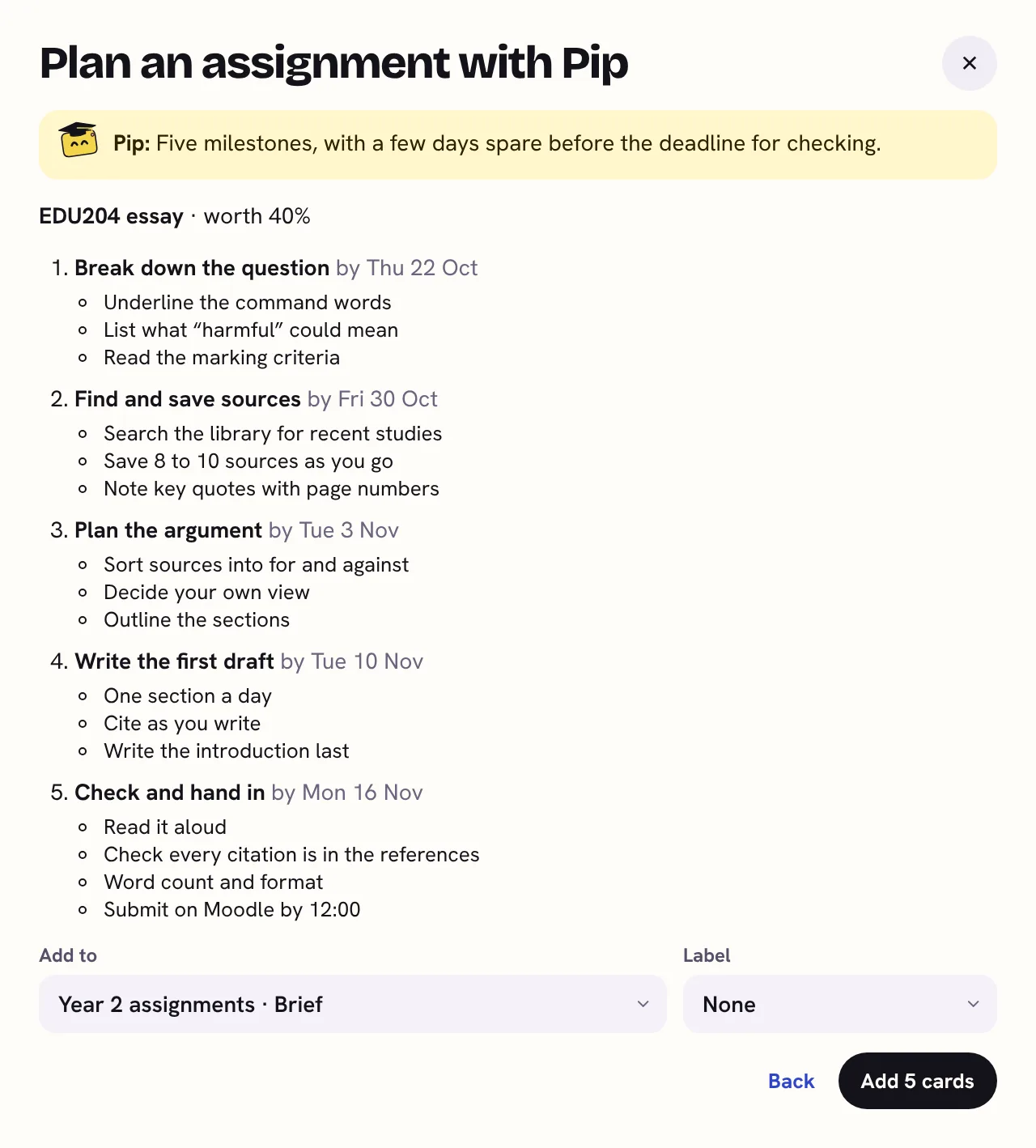
The essay from step 1 was set on Tuesday 20 October and is due at 12:00 on Monday 16 November. Working back, with the weekend before the deadline kept as spare time:
| Milestone | Done by | Small steps |
|---|---|---|
| Break down the question | Thu 22 Oct | Underline the command words; list what “harmful” could mean; read the marking criteria |
| Find and save sources | Fri 30 Oct | Search the library for recent studies; save 8 to 10 sources as you go; note key quotes with page numbers |
| Plan the argument | Tue 3 Nov | Sort sources into for and against; decide your own view; outline the sections |
| Write the first draft | Tue 10 Nov | One section a day; cite as you write; write the introduction last |
| Check and hand in | Mon 16 Nov, 12:00 | Read it aloud; check every citation is in the references; word count and format; submit |
Bigger pieces: a dissertation timeline
For a dissertation due at the end of April, the same idea works month by month. Your department’s dates come first: the proposal, the ethics deadline and any draft deadlines.
| When | What |
|---|---|
| October | Research question, proposal and ethics application |
| November and December | Reading and the literature review |
| January | Methodology, and collecting your data |
| February | Analysis and the findings chapter |
| March | Discussion and conclusion, then the introduction |
| April | Final checks, the abstract, formatting, and a spare week before hand-in |
Add your supervisor meetings as cards with dates. A meeting with a draft to discuss is worth far more than one without.
When deadlines clash
- Sort by date and by weight. A 50% essay due in three weeks may need more of this week than a 10% quiz due on Friday.
- Work in turns, not all at once. Give each day to one piece where you can. Switching all day costs time.
- Ask early. If two big deadlines land on the same day, tell your tutors now. Some will help; extensions are easier to get early.
 Plan back from the deadline in KanBananza
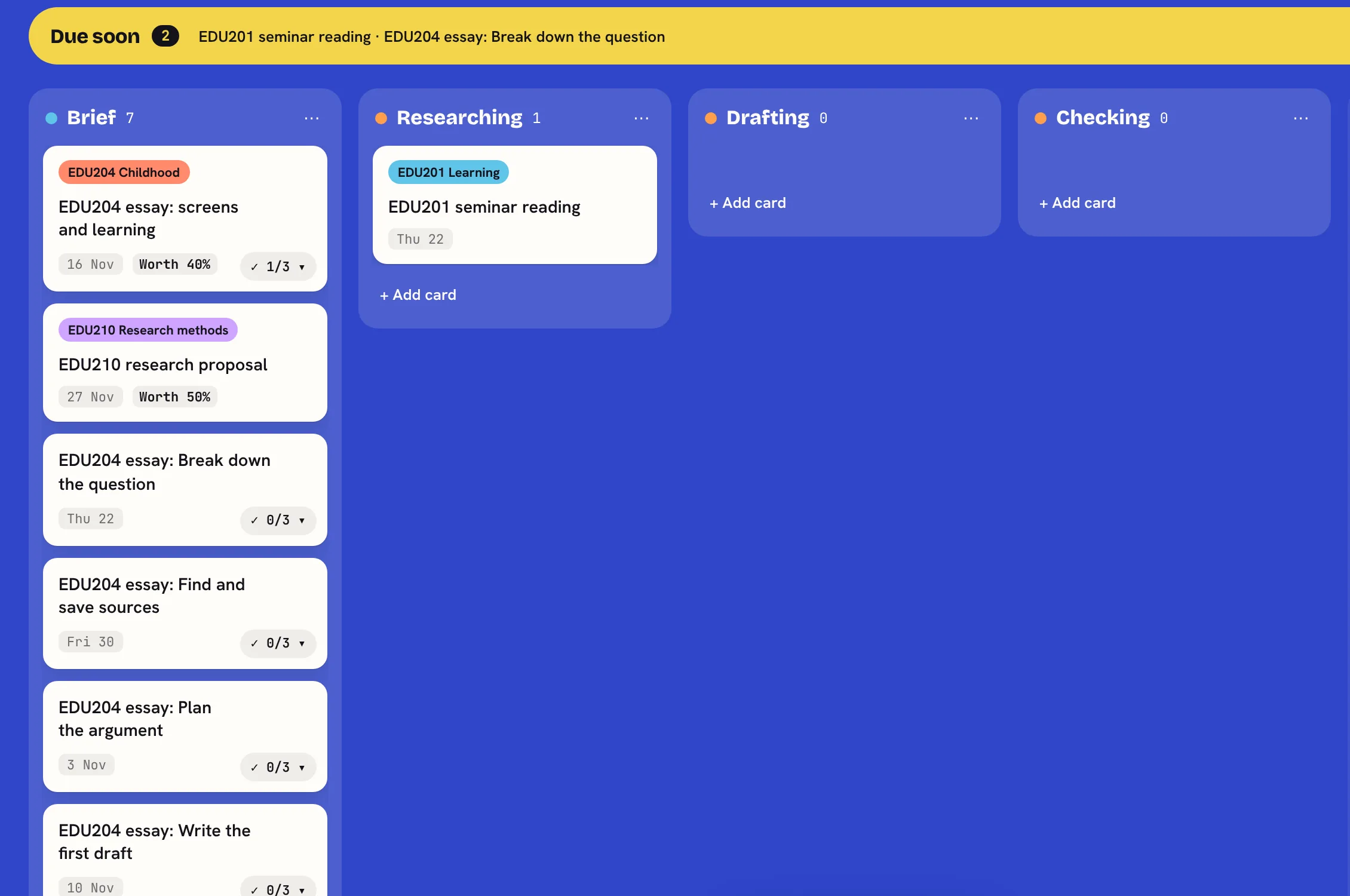
- Plan an assignment (in Pip’s menu): paste the brief, add the deadline if the brief doesn’t say it, and Pip suggests three to six dated milestones with small steps. Pick the board and column, then Add: each milestone becomes a card due at 5pm, with its steps as a checklist. Pip
- Due dates on any card, and Due soon in the bar at the top shows what’s due in the next three days. Free
- Term dates in Settings → Study show “Week 5 of 11” under the clock, and count down to exams. Free
- Snooze a card until the week you’ll start it, so today’s board stays calm, and Add to today’s plan for the steps you’ll do today (3 cards free, up to 10 with Full Bananza). Free
- Worth on each card, and Import a calendar file or a live calendar link from Moodle, Canvas or Outlook to bring every deadline in at once. Full Bananza
For your level
School and college
Your teacher may set draft dates for coursework or the EPQ. Put those in first, as they’re your real deadlines. Plan around mocks and revision too.
University essays and reports
Put every deadline for the term on one board at the start of term. It’s much easier to see clashes in week 1 than in week 9.
Dissertations
Plan by month, then by week for the month you’re in. Treat your supervisor’s draft dates as hard deadlines.
Master’s and PhD
Long projects drift. Set a milestone every four to six weeks that someone else will see, like a chapter draft for your supervisor.
Questions
How far ahead should I start an assignment?
The day it’s set, even if you only break down the brief. As a rough guide, give a 2,000-word essay two to three weeks, a big coursework piece four to six weeks, and a dissertation five to six months.
How do I make a dissertation timeline?
Put the hand-in date at the end and keep the last week free. Then work back: final checks, introduction and conclusion, discussion, findings, data collection, methods, literature review, proposal and ethics. Give each a month or a few weeks, and put supervisor meetings in as dates of their own.
What if I fall behind the plan?
Move the dates, not the deadline. Look at what’s left, shrink each stage a little, and use the spare days. If you’re a week or more behind on something big, talk to your tutor early about an extension.
Should I ask for an extension?
If illness, caring, work or something else outside your control is getting in the way, yes, and early. Most schools and universities have a process, and it’s much easier before the deadline than after it.
How many hours a day should I work on an assignment?
Shorter, regular sessions beat long ones. Two or three focused 25-minute sessions a day, most days, will get a 2,000-word essay done in two weeks without an all-nighter.
All 7 steps
- Break down the brief
- Plan back from the deadline
- Find and save sources
- Reference as you go
- Plan the chapters
- Sources for each chapter
- Write, check and hand in
KanBananza is free for Chrome, Edge and Firefox. No account, no tracking, and every accessibility option included.
Add to Chrome, it's freeAlso for Edge and Firefox. Full Bananza from £5 a year, or try it free for 7 days.