
In short
- Read the brief twice, slowly, then once more with a pen.
- Underline the command words: they tell you what to do (evaluate, compare, discuss).
- Circle the topic and its limits: who, where, when and which ideas.
- Write down the word count, format, referencing style, deadline and how to hand it in.
- Read the marking criteria and rewrite the question in your own words.
A brief is a set of instructions, and most lost marks come from not following them. The essay answers a slightly different question, or describes when it should argue, or forgets the word count. Ten minutes of careful reading fixes all three.
This is step 1 of planning an assignment from start to finish. It works for an essay, a report, a presentation, a coursework piece or a dissertation proposal.
How to break down a brief
Read the whole brief, twice
First for the gist, then slowly. Read anything attached to it as well: the module handbook page, the marking grid, and any notes from the lecture where it was set.
Underline the command words
These are the verbs that say what to do: analyse, compare, critically evaluate, to what extent. They decide the shape of your answer. The table below says what each one means.
Circle the topic and its limits
The topic is what it’s about. The limits narrow it down: an age group, a country, a time period, a theory, or “with reference to two case studies”. Writing outside the limits doesn’t earn marks.
Find the practical details
Word count, format (essay, report, reflective piece), referencing style, how many sources, the deadline and its time, and where to hand it in. Note them all in one place.
Read the marking criteria
The criteria (sometimes called the rubric, the learning outcomes or the assessment objectives) say what earns the top marks. Look at the words in the highest band, like “critical”, “wide range of sources” or “clear structure”. They’re your checklist for the end.
Rewrite the question in your own words
One sentence: “I need to argue whether… using… in about… words.” If you can’t write it, you’re not ready to start reading.
List what you don’t know, and ask
Unclear words, whether the word count includes citations, what “academic sources” covers. Ask your tutor or teacher this week, in writing.
Command words and what they mean
Different words ask for different answers. Describing when the brief says “evaluate” is the most common reason a good essay gets an average mark.
| Command word | What it asks you to do |
|---|---|
| Analyse | Break it into parts and explain how they work and fit together. |
| Assess | Weigh up how important or effective something is, and give a judgement. |
| Compare | Show the similarities, and usually the differences too. |
| Contrast | Show the differences. |
| Critically evaluate | Judge the strengths and weaknesses using evidence, then reach your own reasoned conclusion. |
| Define | Give the precise meaning, often with a source for it. |
| Describe | Say what something is like or what happened. No judgement needed. |
| Discuss | Explore the topic from different sides and explain the arguments. |
| Evaluate | Judge how good, true or useful something is, with evidence. |
| Examine | Look at it in detail and question it. |
| Explain | Say how or why something happens, clearly. |
| Justify | Give good reasons and evidence for a view or a decision. |
| Outline | Give the main points briefly, without detail. |
| Reflect | Think about your own experience or learning and what you’d do differently. |
| Summarise | Give the main points in a short, clear form. |
| To what extent | Decide how far something is true, with evidence on both sides, and say where you land. |
A brief, taken apart
Here’s a real-looking second-year brief, and what each part of it is telling you.
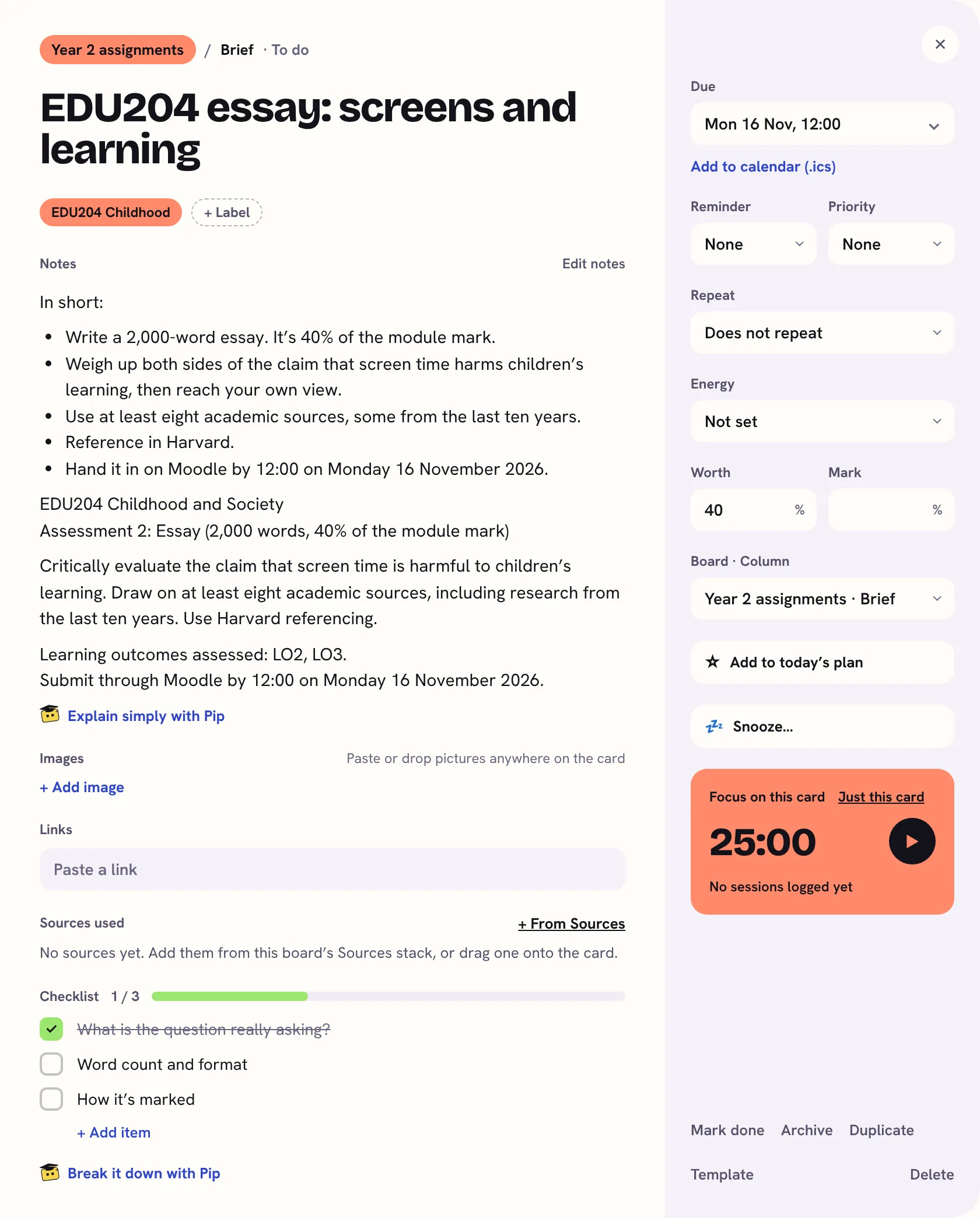
Critically evaluate the claim that screen time is harmful to children’s learning. Draw on at least eight academic sources, including research from the last ten years. Use Harvard referencing. 2,000 words, 40% of the module mark.
| Part | In this brief | What it means for you |
|---|---|---|
| Command words | Critically evaluate | An argument, not a description. Both sides, then your own view. |
| Focus | The claim that screen time is harmful | You’re judging a claim, so test it: harmful how, for whom, and how strong is the evidence? |
| Topic and limits | Children’s learning | Learning, not sleep or mood in general, unless you link it back to learning. |
| Sources | Eight or more, some from the last ten years | Aim for ten. Include recent research, not only older classics. |
| Practical details | Harvard, 2,000 words, 40% | Set the board’s style to Harvard. It’s the biggest piece this term, so it comes first. |
Your one-sentence version might be: “I need to argue how far the evidence shows screens harm children’s learning, using ten good sources, in 2,000 words.”
Check the practical details
- Word count: the limit, whether there’s a margin (some courses allow 10% over, many don’t), and what counts.
- Format: essay, report, reflective account, poster or presentation. Reports need headings; essays usually don’t.
- Referencing style: named in the brief or the handbook. Set it before you save your first source (step 4).
- Deadline and time: 12:00 and 23:59 are very different days. Note the time too.
- How to hand it in: the portal, the file type, a cover sheet, your student number instead of your name.
- Extensions: where the policy is, in case you need it. Asking early is always easier.
 Break down a brief in KanBananza
- Make a card for the assignment and give it the due date and time. Paste the brief into its Notes. Free
- Add the questions above as a checklist with + Add item. On the board the card shows how many are done, like ✓ 1/3. Free
- The ready-made Assignments and coursework board already has a Break down the brief card with these questions. Free
- Set Worth to the percentage the brief gives, so the biggest pieces stand out. Full Bananza
- Explain simply with Pip turns the brief into three to seven plain bullet points, keeping every date, number and word count exactly. It adds them under “In short:” and keeps the original brief below. Pip
Next, plan back from the deadline, or let Pip suggest the milestones with Plan an assignment.
For your level
School and college
For GCSE and A-level coursework (NEA), the exam board’s assessment objectives are the marking criteria. For BTEC, the Pass, Merit and Distinction criteria are the brief: plan for the grade you’re aiming at. For the EPQ, you write the question yourself, so make it specific enough to argue.
University essays and reports
The module handbook and the learning outcomes matter as much as the question. Look at the marking grid for your level, since what earns a first changes from year 1 to year 3.
Dissertations
Your research question is the brief you write yourself, and the dissertation handbook sets the rules: word limit, structure, ethics and deadlines. Read both, then agree the question with your supervisor.
Master’s and PhD
Programme regulations set the word limits, formats and deadlines, and they’re strict. Keep them in a card’s notes so they’re a click away when you need them.
Questions
What does “critically evaluate” mean?
Weigh up the strengths and weaknesses of a claim, a theory or some evidence, using sources, and then give your own reasoned judgement. It’s not enough to describe what others say: you need to say how convincing it is, and why.
What’s the difference between “discuss” and “evaluate”?
Discuss asks you to explore a topic from different sides and explain the arguments. Evaluate goes a step further: you judge how good or how true something is and come to a conclusion. Many briefs ask for both.
Does the word count include references?
Usually the reference list isn’t counted, but in-text citations often are. Headings, tables and appendices vary. Your course handbook says for certain, so check it and note the answer on your assignment card.
What if the brief is unclear?
Ask early, in writing, so you have the answer to look back on. Your tutor or teacher would rather answer a question in week one than read an essay that missed the point. Paste the reply into the card’s notes.
Can AI help me understand a brief?
Many schools and universities allow AI for understanding a task but not for writing it. Check your course’s rules first. In KanBananza, Explain simply with Pip turns a brief into a few plain bullet points and keeps the original underneath, so you can compare.
All 7 steps
- Break down the brief
- Plan back from the deadline
- Find and save sources
- Reference as you go
- Plan the chapters
- Sources for each chapter
- Write, check and hand in
KanBananza is free for Chrome, Edge and Firefox. No account, no tracking, and every accessibility option included.
Add to Chrome, it's freeAlso for Edge and Firefox. Full Bananza from £5 a year, or try it free for 7 days.