
In short
- Write one section at a time, starting with the one you know best.
- Work in short focus sessions with breaks, and plan the next one before you stop.
- Edit in passes: argument, then evidence, then paragraphs, then sentences, then references.
- Go through a final checklist: question, criteria, word count, references, format.
- Hand it in early, check the receipt, and save your feedback for next time.
By this point you have a plan, your sources and a card for every section. Writing is now a series of small jobs. The hard part is starting each one, and the trick is to make the start very small.
This is the last step of planning an assignment from start to finish.
Write one section at a time
Start with the section you know best
Momentum matters more than order. For a dissertation that’s often the methodology; for an essay, the point you feel surest about.
Write a rough version first
Get the ideas down without stopping to polish. A messy complete draft is worth more than one perfect paragraph.
Cite as you go
Put each citation in as you use a source, with its page number. It’s much harder to find later.
Move the card when it’s drafted
On to Redrafting, or to your supervisor. Each move is visible progress.
Leave the introduction and conclusion till last
Then you know exactly what you’re introducing and concluding.
Short, focused sessions
- 25 minutes on, 5 off. The Pomodoro technique: after four rounds, a longer break. Short sessions are easier to start and harder to waste.
- One card, one job. Before a session, decide the one thing you’re doing. “Write the paragraph on eReaders”, not “work on essay”.
- Hide everything else. Phone in another room, other tabs closed, notifications off.
- When it won’t start, set 10 minutes and write badly on purpose. Or work alongside a friend, on a call or in the library.
Edit in passes
Trying to fix everything in one read means missing most of it. Read through several times, looking for one kind of thing each time.
Argument and structure
Does it answer the question, using the command words? Does each section make one clear point, in a sensible order?
Evidence
Is every claim backed by a source? Have you explained how the evidence supports your point, not just quoted it?
Paragraphs and flow
Does each paragraph lead into the next? Are there signposts, like “However” or “This suggests”?
Sentences and words
Read it aloud. Cut what you don’t need. Fix the spelling and grammar.
References and format
Every citation has a reference, every reference is cited, and both follow your style. Headings, figures, tables and page numbers are right.
The final checklist
- It answers the question that was set, including every part of it.
- It meets the marking criteria: look at the top band one more time.
- The word count is within the limit, counted the way your course counts it.
- Every citation is in the reference list, and everything in the list is cited.
- Quotes are in quotation marks, with page numbers.
- The reference list is in your style, with nothing missing.
- Headings, tables and figures are labelled, and appendices are where the handbook says.
- The file is in the right format with the right name, and your name or student number is where it should be.
- If your course asks you to declare any use of AI, you’ve done it.
- It’s uploaded to the right place, and you’ve kept the receipt.
Hand it in early
Aim to submit the day before, or at least a few hours early. Portals slow down near deadlines, and files go wrong. Open the submitted file to check it’s the right version, and save the receipt. If anything goes wrong, email your tutor or school office straight away, with screenshots.
After you hand it in
Move the card to Done and take a proper break. When the mark and feedback come back, add them to the card. Feedback is the best guide you’ll get to the next assignment, so read it while it’s fresh.
 Finish and hand in with KanBananza
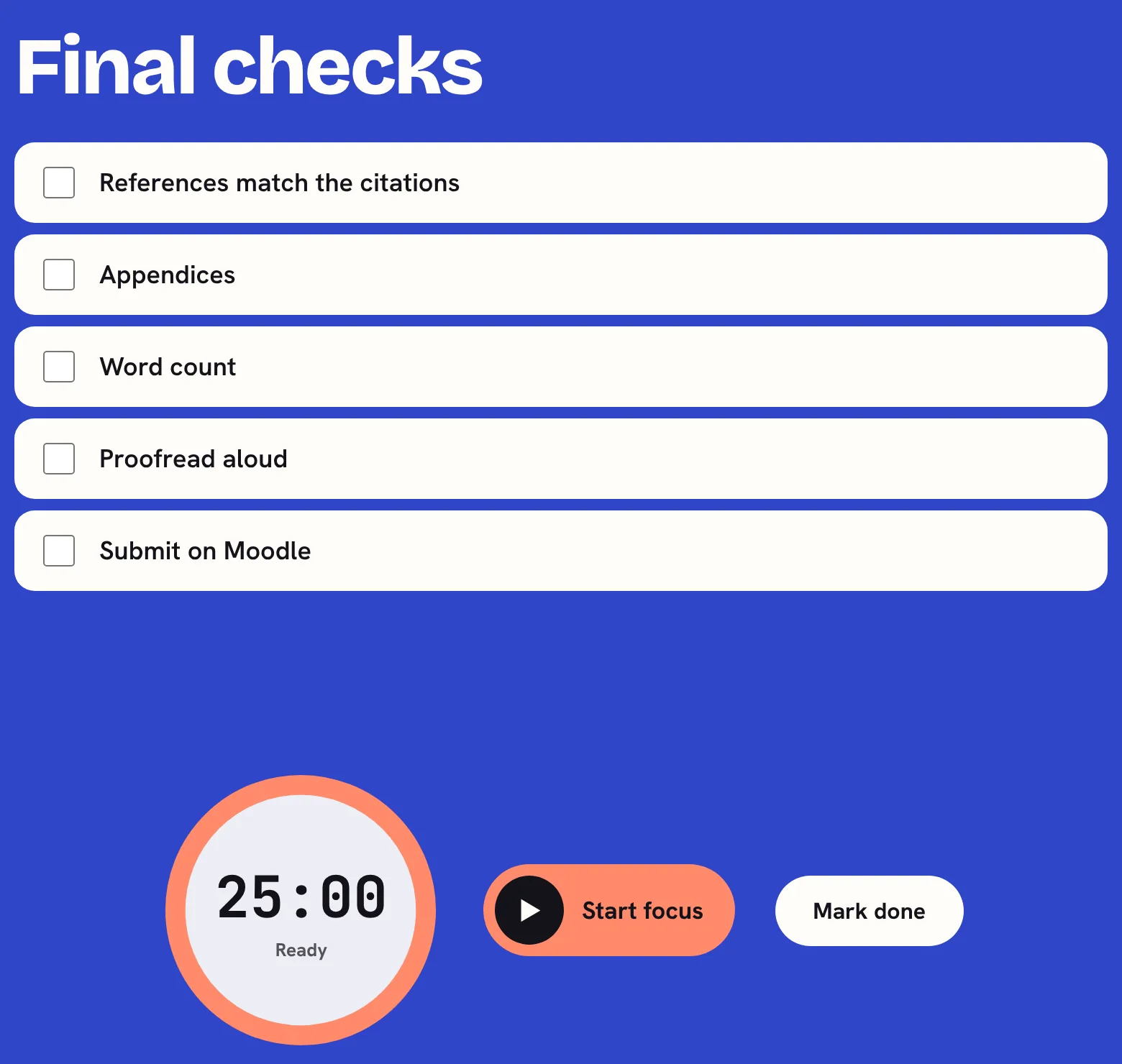
- A Final checks card with your checklist: the ready-made Essay or dissertation and Dissertation, chapter by chapter boards include one, with references, word count and proofreading. Free
- A focus timer on every card (Focus on this card), with short and long breaks, and it can show as a shrinking disc instead of numbers (Settings → Reading and access). Free
- Pick one for me suggests a single card to do next, and says why. Free
- Just this card fills the screen with one card, its steps and a timer. Full Bananza
- Copy reference list on a card pastes into Word or Google Docs with italics and hanging indents. Full Bananza (Copying the whole Sources stack in Harvard is free.)
- Add the Mark to the card when it comes back, next to what it was Worth. Full Bananza
For your level
School and college
Coursework may have a draft deadline where your teacher gives feedback once. Use it: plan to have a full draft by then, not a half one.
University essays and reports
Use your university’s writing support or study skills team for a read-through. Book early in the term, as slots fill up near deadlines.
Dissertations
Leave a full week for formatting, the abstract, contents page, appendices and the final read. It always takes longer than you think.
Master’s and PhD
Check the submission rules early: formatting, word limits, declarations and how many copies. A thesis can fail a technical check before anyone reads it.
Questions
How do I stop putting off my essay?
Make the first step tiny and specific, like “write three sentences about Chang et al.”, and set a timer for 10 or 25 minutes. Starting is the hard part. Clear your screen of everything else, and plan when the next session is before you stop.
How do I proofread my own work?
Leave a gap first, ideally a day. Then read it aloud, or have your computer read it to you (Microsoft Word and Microsoft Edge have read-aloud tools). Check one thing at a time: the argument, then the paragraphs, then the sentences, then the references.
What if I’m going to miss the deadline?
Tell someone before it passes. Most schools and universities have extensions or extenuating circumstances processes, and they work best when used early. Late work often loses marks or isn’t marked at all, so ask.
How early should I submit?
At least a few hours before the deadline, and a day early if you can. Upload portals slow down near deadlines, and files go wrong. Check the receipt and keep it.
Will a plagiarism checker flag my quotes?
Similarity checkers highlight matching text, including properly cited quotes and references. Markers look at what’s highlighted and why, so a cited quote in quotation marks isn’t a problem. Copied text without a citation is.
All 7 steps
- Break down the brief
- Plan back from the deadline
- Find and save sources
- Reference as you go
- Plan the chapters
- Sources for each chapter
- Write, check and hand in
KanBananza is free for Chrome, Edge and Firefox. No account, no tracking, and every accessibility option included.
Add to Chrome, it's freeAlso for Edge and Firefox. Full Bananza from £5 a year, or try it free for 7 days.